Open Access Peer-Reviewed Established 1988

Pakistan Journal of Pharmaceutical Sciences

Pakistan Journal of Pharmaceutical Sciences (PJPS) is an international, peer-reviewed, open-access journal dedicated to publishing high-quality research that advances pharmaceutical, biomedical, and medicinal sciences. Published by the Faculty of Pharmacy and Pharmaceutical Sciences, University of Karachi since 1988, PJPS provides a trusted platform for researchers, academicians, clinicians, and industry professionals worldwide to disseminate innovative discoveries, foster scientific collaboration, and accelerate the translation of research into better healthcare outcomes. We welcome original research, reviews, and emerging innovations that shape the future of pharmaceutical sciences.

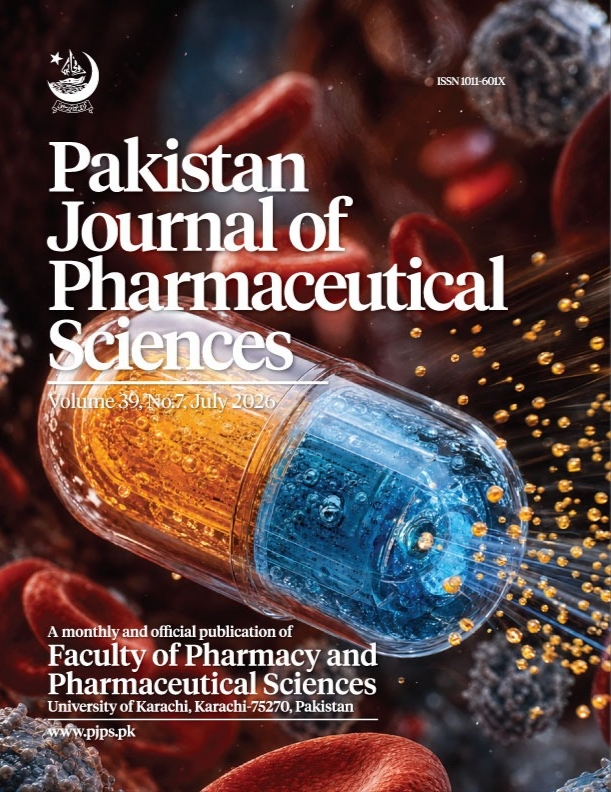
Journal Cover Vol 39
0.6
IMPACT FACTOR
Clarivate Analytics
1011-601X/3105-9686
ISSN PRINT / ONLINE
Since 1988
12400+
TOTAL CITATIONS
Google Scholar
3500+
ARTICLES PUBLISHED
Peer-Reviewed
89+
COUNTRIES REACHED
Global Readership

Latest Research Articles

Browse All Articles
original articlesPublished: 26 Aug 2026
Volume 39, Issue 12

PBPK modeling of intravenous/oral acetaminophen in healthy and pregnant individuals

Abstract: Background: Drug metabolism may be influenced by pregnancy. Use of acetaminophen (APAP) is prevalent among pregnant women, necessitating the development of effective methods for predicting its in-vivo disposition. Objectives: A whole physiologically based pharmacokinetic model was developed to predict the pharmacokinetic behavior of APAP following oral or intravenous administration in both healthy subjects and pregnant women across different trimesters (first, second, and third trimesters). Methods: Phoenix WinNonlin 8.4 was used to establish the model, which was verified by literature data and the fold error method. Sensitivity analysis was used to identify the factors most sensitive to the model results. Results: The model was established successfully. The clearance rate and half-life of intravenous APAP increased during pregnancy and the changes were more obvious with the increase of pregnancy trimesters. Theoretically, adjusting the oral and intravenous doses for pregnant women in the third trimester to 1.23 and 1.16 times those administered to healthy individuals may yield a comparable area under the curve in healthy subjects. According to the sensitivity analysis results, the influencing factors were ranked from largest to smallest as follows: activity of sulfatase > activity of glucuronidase > the constant of the gastrointestinal transport rate > activity of CYP450. Conclusion: Pregnancy affects the metabolism of APAP and more attention should be paid to pregnant women in clinical medication.

Page No:3706-3716
Weimin Kong, Yiting Yang, Xinru GuanView more
View Abstract
original articlesPublished: 26 Aug 2026
Volume 39, Issue 12

Rapid analysis of the chemical composition of the Equiseti hiemalis herba based on UHPLC-Q-Exactive Orbitrap MS with parallel reaction monitoring

Abstract: Background: Equiseti hiemalis herba (EH) is traditionally used for heat-clearing, promoting diuresis, resolving phlegm, relieving cough, improving vision and reducing ocular opacity. Previous phytochemical studies on EH have mainly focused on flavonoids and organic acids, whereas a comprehensive characterization of its chemical constituents remains lacking. Objectives: This study aimed to establish a rapid and systematic analytical strategy for the comprehensive characterization of chemical constituents in EH. Methods: In this work, a UHPLC-Q-Exactive Orbitrap MS system was employed for compound identification, utilizing full MS scan with subsequent data-dependent MS2 acquisition or parallel reaction monitoring incorporating an inclusion ion list. Results: A total of 82 compounds were identified or tentatively characterized from EH, including 34 organic acids, 22 flavonoids, 10 terpenes, 3 nucleotides, 3 amino acids, 3 coumarins, 2 alkaloids and 5 other compounds. Among them, 71 compounds were reported in EH for the first time. Organic acids and flavonoids were the predominant constituents, while the identification of terpenes further revealed the chemical diversity of EH. Conclusion: The established analytical strategy provides an effective approach for the rapid characterization of chemical constituents in EH and offers a theoretical basis for further studies on its pharmacodynamic material basis and pharmacological mechanisms.

Page No:3694-3705
Qing Li, Pei Xiong, Min ZhangView more
View Abstract
original articlesPublished: 26 Aug 2026
Volume 39, Issue 12

Machine learning prognostic model and drug survival analysis for lung adenocarcinoma in the context of radiotherapy

Abstract: Background: Patients with lung adenocarcinoma (LUAD) receiving radiotherapy represent an important but underexplored clinical subgroup. These patients often undergo concomitant pharmacologic treatments, yet the prognostic impact and underlying determinants of such combined regimens remain poorly understood. Objective: This retrospective observational study aimed to develop and validate a radiotherapy-specific machine learning prognostic model for LUAD and to compare survival across concomitant pharmacologic regimens. Methods: In this retrospective observational study, using genomic and clinical data from TCGA, a radiotherapy-specific prognostic model for LUAD was developed and validated through ten machine learning algorithms. Survival analyses were conducted across distinct concomitant pharmacologic strategies, followed by functional enrichment to elucidate molecular mechanisms underlying differential outcomes. Results: Demonstrating robust prognostic abilities, the model efficiently sorted patients into high- and low-risk categories. Both treatment type and risk score independently predicted overall survival, with significant interaction effects. Low-risk patients receiving targeted or combination therapy—mainly erlotinib, gefitinib, or bevacizumab—exhibited substantially improved survival compared with those receiving conventional chemotherapy. Enrichment of "Exogenous peptide presentation," "MHC class II assembly," "Peptide–MHC II assembly," and "Symbiotic interaction" pathways indicated immune modulation and host–tumor crosstalk as key mediators of treatment efficacy. Conclusion: This study establishes a radiotherapy-specific prognostic model for lung adenocarcinoma, demonstrating distinct molecular and therapeutic heterogeneity and highlighting the superior survival benefit of targeted combination therapy in low-risk patients.

Page No:3683-3693
Zaishuang Ju, Yutong Wu, Lili TianView more
View Abstract
original articlesPublished: 26 Aug 2026
Volume 39, Issue 12

Formulation, evaluation and characterization of fexofenadine IR and paracetamol SR multiparticulate drug delivery system

Abstract: Background: Multiparticulate Drug Delivery (MDD) system are particularly considered as well suited systems for controlling oral preparations that have low risk of dose-dumping. Objectives: The current research work was aimed to prepare Fexofenadine HCl immediate release (IR) and Paracetamol sustained release (SR) pellets in a single dosage unit for the treatment of Allergic Rhinitis. Extrusion-spheronization was used to fabricate pellets. Methods: The formulations were analyzed for several parameters, including micromeritic studies, Friability, Weight variation test, Swelling, X-Ray Diffraction (XRD), Fourier Transform Infrared Spectroscopy (FTIR), Scanning Electron Microscopy (SEM), in-vitro release and stability studies. Results: The results showed that the formulated pellets have an excellent flowability (23.01° to 25.23°), bulk density falls in the range of 1.23 g cm-3 to 1.42 g cm-3, tapped density ranges 1.43 g/cm3 1.58 g/cm3, carr’s compressibility index lie between 10.31 % to 15.17 %, Hausner's ratio ranges 1.11 to 1.18 which concluded pellets had good flow properties. Friability was less than 1%; the T6 formulation showed the maximum swelling of 99.28%. No interaction between excipient and drug was found. T6 showed a drug release of 99.08% in 24 hours. Conclusion: The research effectively demonstrated that preparing a single-unit dosage form of paracetamol and fexofenadine is a safe, simple and promising technique for SR of Paracetamol, thereby increasing patient compliance by reducing the dosage frequency.

Page No:3671-3682
Muhammad Sajid Nawaz, Muhammad Zaman, Huma HameedView more
View Abstract
original articlesPublished: 26 Aug 2026
Volume 39, Issue 12

Anti-inflammatory agents after hip and shoulder arthroplasty: A systematic review and meta-analysis

Abstract: Background: Postoperative inflammation after arthroplasty contributes to pain, delayed mobilization and prolonged hospitalization. Recent randomized trials have evaluated pharmacological anti-inflammatory strategies within contemporary enhanced recovery pathways, but evidence after hip and shoulder arthroplasty remains scattered across different drug classes and perioperative regimens. Objectives: To synthesize recent randomized controlled trial (RCT) evidence on perioperative anti-inflammatory agents after hip and shoulder arthroplasty. Methods: PubMed, Embase, Cochrane Library and Web of Science were searched for English-language RCTs published from January 2020 to March 2026. The 2020-2026 window was selected to update evidence generated under modern arthroplasty, anesthesia, multimodal analgesia and enhanced recovery after surgery (ERAS) pathways. Eligible trials included adults undergoing hip or shoulder arthroplasty and compared corticosteroids, cyclooxygenase-2 (COX-2) inhibitors, nonsteroidal anti-inflammatory drug (NSAID)-based/local anti-inflammatory regimens, or related anti-inflammatory interventions with placebo, saline, no treatment, or the same regimen without the target component. Weighted mean differences (WMDs) were pooled using random-effects models. Results: Nine RCTs involving 800 patients were included. Anti-inflammatory interventions significantly reduced postoperative C-reactive protein (CRP) [WMD=-32.18, 95% confidence interval (CI) (-41.16, -23.21), P<0.001], interleukin-6 (IL-6) [WMD=-31.25, 95% CI (-41.79, -20.77), P<0.001], rest pain [WMD=-0.41, 95% CI (-0.58, -0.23), P<0.001], activity pain [WMD=-0.56, 95% CI (-0.83, -0.29), P<0.001] and hospital stay [WMD=-0.54, 95% CI (-0.92, -0.15), P=0.006]. Conclusion: Recent RCT evidence suggests that perioperative anti-inflammatory interventions can attenuate early inflammatory responses and improve short-term pain and recovery after hip and shoulder arthroplasty. Because data were limited and clinically heterogeneous, the findings should not be interpreted as evidence favoring a specific drug class, dose, route, or timing.

Page No:3657-3670
Huang Ling, Zhang Yu, Deng Shu
View Abstract

Browse by Topic

Research Scope & Subjects

Editorial Leadership

View Former Editors-in-Chief

Prof. Dr. Harris Shoaib

Editor-in-Chief

Faculty of Pharmacy and Pharmaceutical Sciences, University of Karachi, Karachi, Pakistan.

Specializing in Pharmacognosy and Natural Products Research, with over three decades of contribution to global pharmaceutical sciences.

2020 — PRESENT

Indexed & Abstracted in Leading Databases