Open Access Peer-Reviewed Established 1988

Pakistan Journal of Pharmaceutical Sciences

Pakistan Journal of Pharmaceutical Sciences (PJPS) is an international, peer-reviewed, open-access journal dedicated to publishing high-quality research that advances pharmaceutical, biomedical, and medicinal sciences. Published by the Faculty of Pharmacy and Pharmaceutical Sciences, University of Karachi since 1988, PJPS provides a trusted platform for researchers, academicians, clinicians, and industry professionals worldwide to disseminate innovative discoveries, foster scientific collaboration, and accelerate the translation of research into better healthcare outcomes. We welcome original research, reviews, and emerging innovations that shape the future of pharmaceutical sciences.

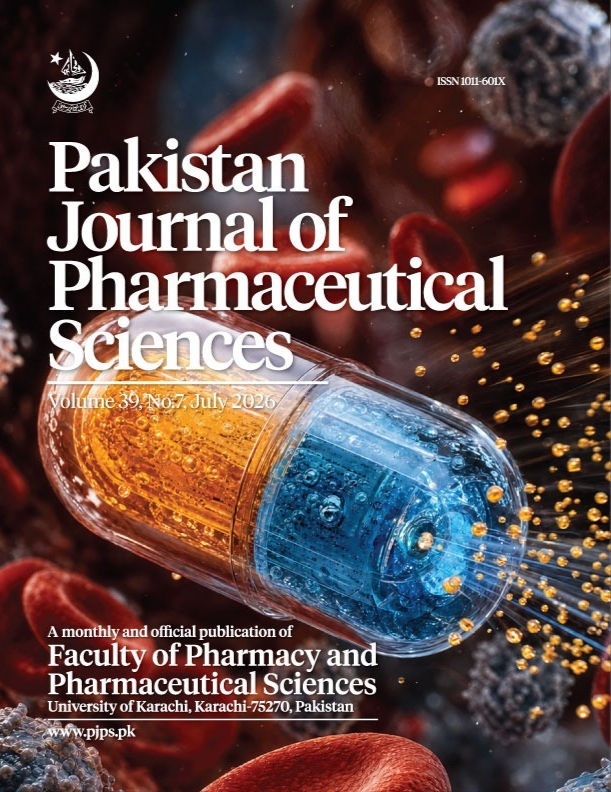
Journal Cover 39 Issue 11
0.6
IMPACT FACTOR
Clarivate Analytics
1011-601X/3105-9686
ISSN PRINT / ONLINE
Since 1988
12400+
TOTAL CITATIONS
Google Scholar
3500+
ARTICLES PUBLISHED
Peer-Reviewed
89+
COUNTRIES REACHED
Global Readership

Latest Research Articles

Browse All Articles
original articlesPublished: 01 Dec 2026
Volume 39, Issue 12

A Notch signaling antagonist (DAPT) ameliorates autoimmune arthritis in mice by suppressing Th1 and Th17 immune responses

Abstract: Background: Rheumatoid arthritis (RA) is a chronic inflammatory autoimmune disease for which targeted therapies remain limited. The Notch signaling pathway has been implicated in T cell differentiation and autoimmune inflammation. Objectives: This study aimed to investigate the therapeutic effects of the Notch signaling antagonist DAPT on autoimmune arthritis in mice and to explore its underlying immunological mechanisms. Methods: A collagen-induced arthritis (CIA) mouse model was established. DAPT (100 ng/kg) or PBS was administered intraperitoneally every other day from day 0 to day 36. Notch pathway activation in CD4+ T cells and synovial tissues was assessed by Western blot and immunohistochemistry. Arthritis severity was evaluated by clinical scoring, radiological examination and histopathology. Th1, Th17 and Treg cell frequencies and absolute numbers in spleen and lymph nodes (LNs) were analyzed by flow cytometry. Plasma cytokine levels were measured by multiplex assay. In-vitro Th17 differentiation assays were performed with DAPT or a Notch agonist. Results: Compared with normal mice, CIA mice showed significant upregulation of NICD expression in CD4+ T cells and synovial tissues. DAPT treatment significantly reduced clinical arthritis scores, joint erosion and cartilage destruction. DAPT also decreased the frequencies and absolute numbers of Th1 and Th17 cells in the spleen and LNs, alongwith reduced plasma levels of IFN-γ and IL-17. In-vitro, DAPT suppressed Th17 differentiation, while Notch agonist enhanced it. Treg cells were not significantly altered by DAPT. Conclusion: The Notch signaling antagonist DAPT ameliorates autoimmune arthritis in mice by suppressing Th1 and Th17 immune responses, highlighting Notch signaling as a potential therapeutic target for RA.

Page No:3825-3834
Hui Chen, Guangjie Pan, Pingshan YangView more
View Abstract
original articlesPublished: 01 Dec 2026
Volume 39, Issue 12

Protective effects of Astragalus microcephalus polysaccharides combined with vitamin E and selenium against mercury-induced ovarian toxicity in female rats

Abstract: Background: Exposure to mercury (Hg) is well-established to induce menstrual cycle disorders and disrupt sex hormone functions. Astragalus species, characterized by their potent antioxidant and anti-apoptotic properties, have shown potential in mitigating these adverse effects by promoting folliculogenesis and restoring hormonal balance. Objectives: This study aimed to evaluate the protective effects of Astragalus microcephalus polysaccharides (APS), both alone and in combination with vitamin E and selenium (Vit E+Se), against ovarian damage and oxidative stress induced by mercuric chloride toxicity in rats. Methods: Thirty-six female Wistar rats were synchronized via vaginal smear and randomly assigned to six groups: Control, Mercury (0.43 mg/kg HgCl2), APS (2.7 g/kg), Vit E+Se, Mercury+APS and Mercury+Vit E+Se. Following a 15-day subacute exposure period, serum levels of estradiol, LH and FSH were measured. Oxidative stress markers and ovarian histopathology were evaluated. Apoptotic and inflammatory pathways were assessed through immunohistochemical staining of Caspase-3, AIF and NF-κB. Results: Hg-induced reductions in hormone levels were significantly restored to near control levels in the APS-treated groups and antioxidant levels were notably elevated in these groups, indicating mitigation of oxidative stress. Furthermore, immunohistochemical analysis revealed a significant reduction in stromal and follicular degeneration and a decrease in apoptotic activity in the ovaries of rats treated with APS. Conclusion: APS exerts a significant protective effect against mercury-induced ovarian toxicity. This protection is mediated through the attenuation of oxidative stress, inflammation and apoptosis, as evidenced by the modulation of Caspase-3, AIF and NF-κB pathways. The results suggest that APS, particularly in synergy with vitamin E and selenium, offers a potential therapeutic strategy for managing heavy metal-induced reproductive damage.

Page No:3814-3824
Kurt Begum, Sahin Mahmut, Kumru Alper SView more
View Abstract
original articlesPublished: 01 Dec 2026
Volume 39, Issue 12

Albiflorin suppresses breast cancer via the HINT2/NLRP3 signaling pathway

Abstract: Background: Breast cancer (BC) remains a significant global health threat with complex pathogenesis often linked to chemotherapy resistance and inflammatory microenvironments. Histidine triad nucleotide-binding protein 2 (HINT2) is a mitochondrial protein involved in metabolism and immunity, but its specific role in BC and potential as a therapeutic target require further elucidation. Objectives: This study aimed to identify novel therapeutic targets for BC and evaluate the anti-tumor efficacy and molecular mechanisms of Albiflorin (Al), a natural monoterpene glycoside. Methods: Proteomic profiling was performed on BC xenografts in nude mice to identify differentially expressed proteins. In-vivo and in-vitro models (MDA-MB-231 cells) were established to assess the effects of Al (20 mg/kg or 20 µM) on tumor growth, apoptosis and cytokine production. Molecular docking and co-immunoprecipitation (Co-IP) were used to investigate the interactions among HINT2, NLRP3 and Al. Results: HINT2 was significantly upregulated in BC tissues and identified as a primary pro-tumorigenic factor. Co-IP confirmed an endogenous interaction between HINT2 and NLRP3. Al exhibited strong binding affinity to HINT2 (–7.36 kcal/mol) and significantly suppressed tumor volume and weight. Furthermore, Al treatment downregulated the HINT2/NLRP3 axis, reduced inflammatory cytokines (IL-1β, IL-6, TNF-α) and promoted apoptosis by modulating Caspase-3, Bax and Bcl-2 levels. Conclusion: Albiflorin suppresses BC progression by inhibiting the HINT2/NLRP3 signaling pathway, suggesting HINT2 is a viable biomarker and Al a promising therapeutic agent for BC treatment.

Page No:3805-3813
Yunpeng Hu, Chen Li, Yiyao Cui
View Abstract
original articlesPublished: 01 Dec 2026
Volume 39, Issue 12

Development of a biomarker-guided chemotherapy response model using combined CEA and CA19-9 profiles in esophageal cancer: A real-world pharmacotherapeutic study

Abstract: Background: Esophageal adenocarcinoma is associated with poor survival despite advances in systemic therapy. Readily available serum biomarkers may improve risk stratification; however, their combined role in biomarker-guided treatment decisions remains insufficiently investigated. Objectives: To evaluate the prognostic significance of combined baseline carcinoembryonic antigen (CEA) and carbohydrate antigen 19-9 (CA19-9) levels and explore their utility for biomarker-based risk stratification in patients with esophageal adenocarcinoma receiving systemic chemotherapy. Methods: This retrospective real-world cohort study included 38 patients with histologically confirmed esophageal adenocarcinoma who received systemic chemotherapy at a tertiary referral center between January 2016 and December 2021. Patients were classified into three exploratory biomarker-defined risk groups according to baseline serum CEA and CA19-9 levels. Overall survival was evaluated using Kaplan–Meier analysis and Cox proportional hazards regression, while treatment outcomes were explored across biomarker-defined groups and chemotherapy regimens. Results: Elevated baseline CEA and CA19-9 levels were associated with shorter overall survival. Patients with simultaneous elevation of both biomarkers demonstrated the poorest survival outcomes (multivariable hazard ratio = 2.22). Differences in survival were observed across chemotherapy regimen groups within biomarker-defined categories; however, these comparisons were exploratory and may have been influenced by treatment-selection bias and unmeasured clinical factors. Patients with distal or gastroesophageal junction adenocarcinoma showed more favorable outcomes than those with cervical or thoracic tuxzmors. Conclusion: Combined assessment of baseline CEA and CA19-9 may provide a practical and inexpensive approach for biological risk stratification in esophageal adenocarcinoma. However, these findings do not establish that the biomarkers can guide chemotherapy selection. Prospective multicenter studies with independent validation are required to determine their prognostic and predictive value before biomarker-guided treatment selection can be recommended in routine clinical practice.

Page No:3790-3804
Orcun Can, Abdullah Sakin
View Abstract
original articlesPublished: 01 Dec 2026
Volume 39, Issue 12

Therapeutic efficacy of naloxone hydrochloride combined with hemoperfusion in toxic acute renal failure via the oxidative stress/Nrf2 pathway

Abstract: Background: Toxic acute renal failure (ARF) involves severe oxidative stress. The Nrf2 pathway is a key antioxidant defense mechanism. Objectives: To investigate whether naloxone combined with hemoperfusion alleviates oxidative injury via Nrf2 activation in toxic ARF. Methods: In this single-center retrospective cohort study at Qiqihar Medical University Hospital, 67 patients were enrolled through medical record screening. The control group (n=39) received hemoperfusion alone; the observation group (n=28) received additional intravenous naloxone (0.8 mg bolus + 2.0 mg/24 h infusion for 7 days). Renal function and oxidative markers were assessed before treatment, at 24 h and day 7. Multivariate regression analysis was used to adjust for confounding factors. Separately, 30 rats were randomized into control, model and treatment groups (n=10 each). The treatment group received intraperitoneal naloxone (1.0 mg/kg) plus simulated hemoperfusion. Results: After adjusting for baseline imbalances, combined therapy was independently associated with significant reductions in Scr and BUN in patients (adjusted β = -8.52, 95% CI: -12.37 to -4.67, P < 0.001) and with significant improvements in renal function and histopathology in rats. Combined therapy decreased tubular injury markers (β2-MG, KIM-1, NGAL, L-FABP) in rats. Mechanistically, it was associated with activation of the Nrf2/HO-1/NQO1 pathway, enhanced SOD activity and reduced MDA levels. Improvements were time-dependent (24 h to day 7). Conclusions: Naloxone combined with hemoperfusion activates the Nrf2 pathway, attenuates oxidative stress and improves renal function in toxic acute renal failure.

Page No:3778-3789
Yin Zhu, Huichun Sun, Qiuyang WangView more
View Abstract

Browse by Topic

Research Scope & Subjects

Editorial Leadership

View Former Editors-in-Chief

Prof. Dr. Harris Shoaib

Editor-in-Chief

Faculty of Pharmacy and Pharmaceutical Sciences, University of Karachi, Karachi, Pakistan.

Specializing in Pharmacognosy and Natural Products Research, with over three decades of contribution to global pharmaceutical sciences.

2020 — PRESENT

Indexed & Abstracted in Leading Databases