Open Access Peer-Reviewed Established 1988

Pakistan Journal of Pharmaceutical Sciences

Pakistan Journal of Pharmaceutical Sciences (PJPS) is an international, peer-reviewed, open-access journal dedicated to publishing high-quality research that advances pharmaceutical, biomedical, and medicinal sciences. Published by the Faculty of Pharmacy and Pharmaceutical Sciences, University of Karachi since 1988, PJPS provides a trusted platform for researchers, academicians, clinicians, and industry professionals worldwide to disseminate innovative discoveries, foster scientific collaboration, and accelerate the translation of research into better healthcare outcomes. We welcome original research, reviews, and emerging innovations that shape the future of pharmaceutical sciences.

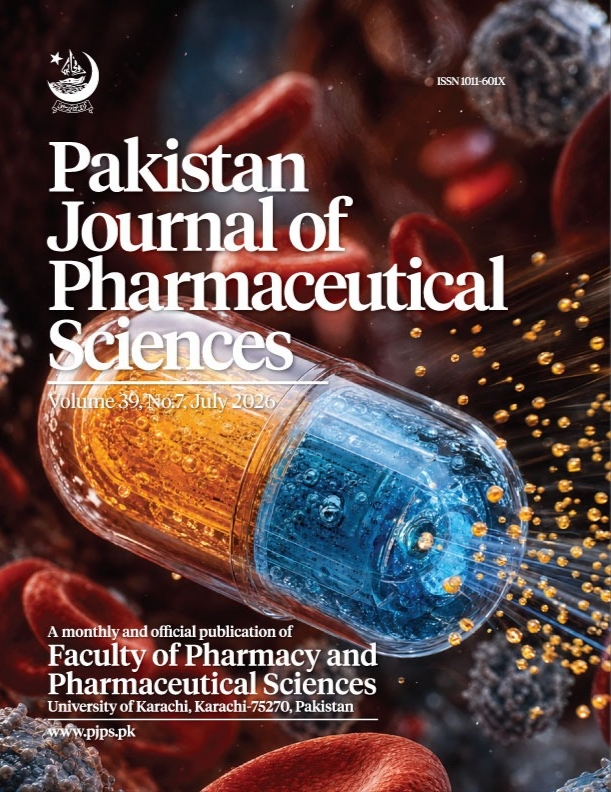
Journal Cover Vol 39
0.6
IMPACT FACTOR
Clarivate Analytics
1011-601X/3105-9686
ISSN PRINT / ONLINE
Since 1988
12400+
TOTAL CITATIONS
Google Scholar
3500+
ARTICLES PUBLISHED
Peer-Reviewed
89+
COUNTRIES REACHED
Global Readership

Latest Research Articles

Browse All Articles
original articlesPublished: 2026-11-01
Volume 39, Issue 11

Astragaloside IV attenuates high glucose-induced podocyte ferroptosis via the GSK3?/Nrf2/GPX4 pathway

Objectives: To investigate whether AS-IV alleviates high glucose (HG)-induced podocyte ferroptosis and whether this effect is associated with the GSK3?/Nrf2/GPX4 axis. Methods: Differentiated MPC-5 podocytes were exposed to HG (30 mmol/L) with or without AS-IV, the GSK3? inhibitor LY2090314, or the ferroptosis inhibitor Ferrostatin-1 (Fer-1). An osmotic control (mannitol) was included. Cell viability was quantified with the CCK-8 assay. Levels of reactive oxygen species (ROS), malondialdehyde (MDA), glutathione (GSH) and Fe²? were measured. Lipid peroxidation was detected using C11-BODIPY 581/591. Mitochondrial morphology was examined by transmission electron microscopy and protein expression was analyzed by Western blot. Results: HG exposure induced podocyte injury, characterized by decreased viability, increased oxidative stress (elevated ROS, MDA and lipid ROS), GSH depletion, iron overload and mitochondrial damage. The osmotic control did not reproduce these effects. AS-IV or Fer-1 significantly attenuated the HG-induced damage and lipid peroxidation. At the molecular level, HG downregulated Nephrin, p-GSK3? (Ser9), Nrf2 and GPX4, while upregulating total GSK3?. AS-IV treatment partially reversed these protein expression changes and produced a protective pattern similar to that of LY2090314. Conclusion: AS-IV alleviates HG-induced podocyte injury, possibly by suppressing ferroptosis and this protective effect may involve modulation of the GSK3?/Nrf2/GPX4 axis. The results offer new insights into DN pathogenesis and support AS-IV as a potential therapeutic candidate.

Page No:3302-3310
Mengya Gao, Hong Jiang, Kangya LeiView more
View Abstract
original articlesPublished: 2026-11-01
Volume 39, Issue 11

Prunasin alleviates OGD/R-induced injury in H9c2 cardiomyocytes via SRC/EGFR-AKT-FoxO-mediated mitochondrial quality control

Background: Myocardial ischemia-reperfusion injury (MIRI) is still difficult to manage clinically, mainly due to limited effective strategies that can simultaneously address oxidative stress, mitochondrial dysfunction and myocardial cell loss. Prunasin is a cyanide glycoside derived from plants of the genus Prunus. Its biological activity has been reported, but its role in ischemia-reperfusion related cardiac injury is not yet clear. Objectives: To evaluate the protective effect of prunasin in an oxygen glucose deprivation/reoxygenation (OGD/R) myocardial cell model and explore its potential mechanism. Methods: Firstly, potential targets and pathways were explored through network pharmacology and molecular docking. Then, functional validation was performed using H9c2 cells subjected to OGD/R. Evaluated cell viability, LDH release, apoptosis, ROS levels, ATP content, mitochondrial membrane potential and key signaling proteins. Results: Network pharmacology highlighted SRC, EGFR and AKT1 as core targets and molecular docking results showed stable binding between prunasin and SRC, supporting this discovery. In experiments, prunasin increased cell viability in a dose-dependent manner and reduced LDH leakage, cell apoptosis and ROS accumulation. Mitochondrial function is also protected, manifested by the recovery of ATP levels and membrane potential. Mechanistically, prunasin activates the SRC/EGFR-AKT-FxO axis, accompanied by enhanced mitochondrial biogenesis, rebalancing of fission/fusion kinetics and increased mitochondrial autophagy, collectively promoting improved mitochondrial quality control under OGD/R stress conditions. Conclusions: Prunasin regulates mitochondrial quality control through the SRC/EGFR-AKT-FxO signaling pathway, thereby reducing OGD/R-induced myocardial cell injury, indicating its potential as a candidate drug for myocardial ischemia-reperfusion intervention.

Page No:3311-3322
Jiang Li, Yaoshu Li, Chengyang XuView more
View Abstract
original articlesPublished: 2026-11-01
Volume 39, Issue 11

Bone marrow mesenchymal stem cells relieve rheumatoid arthritis by blocking JAK/STAT and TLR-4/NF-?B pathways

Background: Rheumatoid arthritis (RA) is a chronic autoimmune disorder characterized by synovial inflammation and joint destruction. Bone marrow mesenchymal stem cells (BMSCs) have shown therapeutic potential in RA, but the underlying mechanisms remain poorly understood. Objectives: To investigate the effects of BMSCs on human RA fibroblast-like synovial MH7A cells and complete Freund's adjuvant (CFA)-induced arthritis in rats and to explore the involvement of the JAK/STAT and TLR-4/NF-?B signaling pathways. Methods: BMSCs were isolated and co-cultured with MH7A cells. CFA-induced arthritis rat models were established. MH7A cell viability, inflammatory cytokine levels, paw withdrawal thermal latency (PWTL), gait parameters and the expression of JAK/STAT and TLR-4/NF-?B pathway-related genes and proteins were assessed. Results: In-vitro, BMSC co-culture significantly inhibited MH7A cell viability and reduced TNF-?, IL-6 and IL-8 levels. BMSC treatment also downregulated the expression of JAK2, p-JAK2, STAT3, p-STAT3, TLR4, P65 and p-P65 in MH7A cells. In-vivo, BMSC administration improved PWTL and gait parameters, reduced serum inflammatory cytokine levels and suppressed the expression of JAK/STAT and TLR-4/NF-?B pathway components in synovial tissues of CFA-induced arthritic rats. Conclusion: BMSCs alleviate RA by inhibiting inflammatory responses in vitro and in vivo and the underlying mechanism may involve blockade of the JAK/STAT and TLR-4/NF-?B signaling pathways.

Page No:3323-3332
Shilin Lian, Xiao Ma, Yichen MengView more
View Abstract
original articlesPublished: 2026-11-01
Volume 39, Issue 11

Mechanisms of Quyu tong-bi decoction for the treatment of type III prostatitis - based on database and in-vitro experiments

Background: Quyu tong-bi decoction (QYTB) has demonstrated significant clinical efficacy in treating type III prostatitis. However, its underlying pharmacological mechanisms remain to be fully elucidated. Objectives: This study aimed to investigate the molecular mechanisms by which QYTB addresses type III prostatitis by integrating network pharmacology, molecular docking and experimental validation. Methods: Active ingredients and potential targets of QYTB were retrieved from the TCMSP and UniProt databases. Disease-associated targets for type III prostatitis were collected from GeneCards, OMIM and TTD. After identifying drug-disease intersection targets, protein-protein interaction (PPI) networks and topological analyses were performed using Cytoscape and STRING. GO and KEGG enrichment analyses were conducted via Metascape. Finally, molecular docking and in-vitro experiments using SP-induced rat spinal cord astrocytes were performed for validation. Results: Thirty-two core targets of QYTB were identified, primarily involving oxidative stress, inflammatory response and apoptosis. In-vitro validation revealed that QYTB-containing serum notably upregulated the concentrations of CAT, SOD and GSH in SP-induced astrocytes while reducing MDA levels. Furthermore, QYTB downregulated pro-inflammatory markers (IL-6, TNF-? and IL-1?) and suppressed the phosphorylation of p38MAPK and CREB within the MAPK signaling pathway. Conclusion: QYTB exerts potent antioxidant and anti-inflammatory effects in the treatment of type III prostatitis, likely through the modulation of the MAPK signaling pathway.

Page No:3333-3345
Miaomiao Ma, Zulong Wang, Baojun Ju
View Abstract
original articlesPublished: 2026-11-01
Volume 39, Issue 11

Real-world pharmacoclinical implementation of risdiplam under a national SMA protocol: A hospital pharmacy registry-based case series

Background: Spinal muscular atrophy (SMA) is a rare neuromuscular disorder treated with disease-modifying therapies such as risdiplam. In Spain, its use is regulated by a national pharmacoclinical protocol that requires structured monitoring. Objectives: To evaluate real-world use, protocol adherence and registry completeness of risdiplam in routine clinical practice. Methods: A retrospective registry-based case series was conducted including patients with spinal muscular atrophy treated with risdiplam.Variables included age, SMA subtype, SMN2 copy number, diagnostic confirmation, treatment sequence and persistence. Protocol adherence was assessed according to national criteria. Results: Ten patients were included in the study. SMA types II and III predominated, with one presymptomatic case. SMN2 copy number ranged from three to four in documented cases. Protocol adherence was confirmed in 70% of patients, while 30% lacked key eligibility variables. No off-protocol prescribing was identified. Treatment persistence was 100% and 60% of patients had previously received nusinersen. Conclusion: Risdiplam was used appropriately in accordance with protocol criteria. Registry incompleteness, rather than clinical deviation, was the main limitation and standardized data capture is essential for real-world evaluation.

Page No:3333-3345
Roberto Lozano, Carina Bona
View Abstract

Browse by Topic

Research Scope & Subjects

Editorial Leadership

View Former Editors-in-Chief

Prof. Dr. Harris Shoaib

Editor-in-Chief

Faculty of Pharmacy and Pharmaceutical Sciences, University of Karachi, Karachi, Pakistan.

Specializing in Pharmacognosy and Natural Products Research, with over three decades of contribution to global pharmaceutical sciences.

2020 — PRESENT

Indexed & Abstracted in Leading Databases