Open Access Peer-Reviewed Established 1988

Pakistan Journal of Pharmaceutical Sciences

Pakistan Journal of Pharmaceutical Sciences (PJPS) is an international, peer-reviewed, open-access journal dedicated to publishing high-quality research that advances pharmaceutical, biomedical, and medicinal sciences. Published by the Faculty of Pharmacy and Pharmaceutical Sciences, University of Karachi since 1988, PJPS provides a trusted platform for researchers, academicians, clinicians, and industry professionals worldwide to disseminate innovative discoveries, foster scientific collaboration, and accelerate the translation of research into better healthcare outcomes. We welcome original research, reviews, and emerging innovations that shape the future of pharmaceutical sciences.

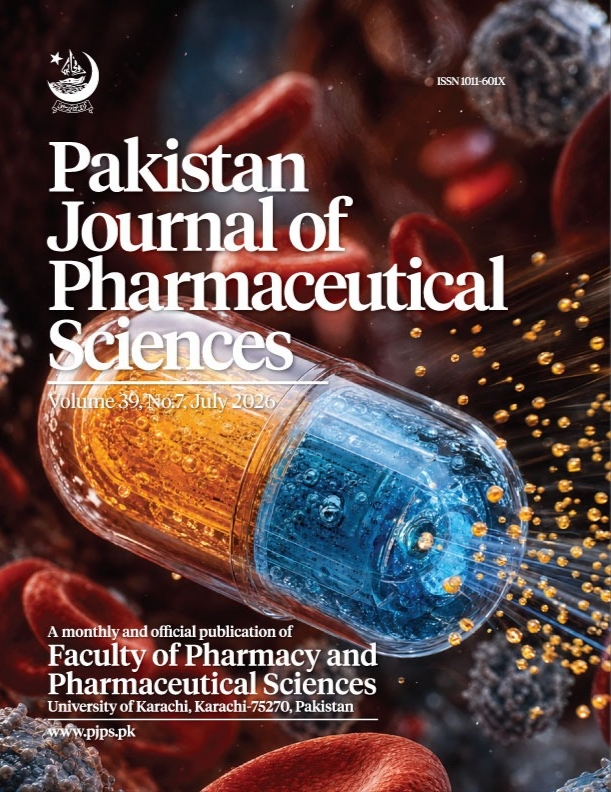
Journal Cover Vol 39
0.6
IMPACT FACTOR
Clarivate Analytics
1011-601X/3105-9686
ISSN PRINT / ONLINE
Since 1988
12400+
TOTAL CITATIONS
Google Scholar
3500+
ARTICLES PUBLISHED
Peer-Reviewed
89+
COUNTRIES REACHED
Global Readership

Latest Research Articles

Browse All Articles
original articlesPublished: 2026-08-23
Volume 39, Issue 12

PGR expression as a pharmacogenomic companion biomarker to GENE70-derived genomic risk in ER-positive/HER2-negative breast cancer

Abstract: Background: The biology of the estrogen receptor-positive (ER+) and human epidermal growth factor receptor 2-negative (HER2-) breast cancers is heterogeneous even when they are categorized by their risk via genomics. Transcriptomic PGR expression reflects endocrine pathway activity and may provide complementary biological information within established GENE70-derived genomic-risk categories. Whether this molecular marker improves the biological interpretation of genomic-risk stratification beyond conventional clinicopathological assessment remains uncertain. Objectives: The aim of this study was to determine whether transcriptomic PGR expression provides complementary biological and prognostic information within reconstructed GENE70-derived genomic-risk categories and refines the characterization of endocrine-related tumour biology in ER-positive/HER2-negative breast cancer. Methods: This study analysed publicly available transcriptomic and clinical data from three cohorts: METABRIC (discovery cohort), GSE96058/SCAN-B cohort (validation cohort) and TCGA-BRCA cohort (molecular validation cohort). The GENE70-derived genomic-risk score was reconstructed for each cohort using matched genes. Cox regression, Kaplan-Meier analysis and subgroup comparisons were used to assess relationships between PGR expression, clinicopathologic variables, molecular features and survival outcomes. Results: Across the three independent cohorts, low transcriptomic PGR expression was consistently associated with higher GENE70-derived genomic risk, increased MKI67 expression, reduced ESR1 expression and enrichment of the Luminal B subtype. Survival findings differed between cohorts. In the discovery METABRIC cohort, transcriptomic PGR expression showed heterogeneous associations with survival, particularly within GENE70-derived high-risk subgroups, whereas the external GSE96058/SCAN-B validation cohort demonstrated consistent associations between low PGR expression and poorer overall survival in both the overall ER-positive/HER2-negative population and GENE70-derived high-risk subgroups. Conclusion: These findings suggest that transcriptomic PGR provides complementary biological and prognostic information within GENE70-derived genomic-risk categories. However, because treatment response was not evaluated in the present study, the findings should not be interpreted as evidence of predictive or pharmacogenomic utility and prospective studies incorporating treatment-response analyses are required before such applications can be established.

Page No:3589-3607
Orcun Can
View Abstract
original articlesPublished: 2026-08-23
Volume 39, Issue 12

Mesalazine enteric-coated tablets combined with retention enema for symptom alleviation in mild to moderate E2-type active ulcerative colitis: A retrospective comparative cohort study

Abstract: Background: Ulcerative colitis (UC) is a chronic inflammatory bowel disease impacting quality of life. Combination oral and topical mesalazine is guideline-recommended for left-sided UC, but real-world data remain limited. Objectives: This retrospective study evaluated the efficacy and safety of mesalazine enteric-coated tablets plus a retention enema in patients with mild-to-moderate E2-type (left-sided) active UC. Methods: Patients with mild to moderate E2-type active UC treated at a single center from January 2021 to December 2022 were retrospectively screened. After applying inclusion and exclusion criteria, 88 patients were included and assigned to either the study group (mesalazine enteric-coated tablets 1.0 g four times daily plus mesalazine retention enema 4.0 g once daily) or the control group (oral mesalazine enteric-coated tablets 1.0 g four times daily alone) based on clinical availability and patient preference. Treatment duration was 30 days. Outcomes included clinical efficacy (using modified local criteria and Mayo score components), symptom relief and time to improvement, endoscopic findings (Mayo Endoscopic Subscore), and adverse events. Results: The “effective” rate was significantly higher in the study group (77.27% vs. 34.09%; OR=6.58, P<0.001). Symptom relief rate was 97.73% vs. 72.73% (OR=13.44, P=0.002). Symptom improvement times were shorter in the study group (all P<0.05). Post-treatment Mayo Endoscopic Subscore was lower in the study group (1.14±0.41 vs. 2.05±0.65; mean difference -0.91, P<0.001). Ulcer and congestion/edema incidences were lower in the study group (6.82% and 18.18% vs. 25.00% and 47.73%). Adverse events were mild and comparable between groups (13.64% vs. 11.36%, P=0.746). Conclusion: Mesalazine enteric-coated tablets combined with retention enema demonstrated superior efficacy compared to oral monotherapy for short-term symptom relief and mucosal healing in patients with mild to moderate E2-type active UC, with a favorable safety profile. Larger prospective studies with longer follow-up are needed to confirm these findings and evaluate long-term outcomes.

Page No:3608-3616
Rui Zhang, Shihui Wang, Mingyue YangView more
View Abstract
original articlesPublished: 2026-08-24
Volume 39, Issue 12

Ultrasound-guided high-voltage vs conventional pulsed radiofrequency in elderly cervical radiculopathy: A randomized controlled trial

Abstract: Background: Elderly patients with cervical radiculopathy present therapeutic challenges owing to comorbidities and medication-related risks. Long-term pharmacotherapy and surgical interventions are often suboptimal, necessitating evaluation of optimized pulsed radiofrequency strategies under image guidance. Objectives: This superiority trial compared the efficacy and safety of ultrasound-guided cervical nerve root high-voltage pulsed radiofrequency (HVP-PRF) versus conventional pulsed radiofrequency (C-PRF) for pain management in elderly patients with cervical radiculopathy. Methods: This single-center, parallel-group, assessor-blinded randomized controlled trial enrolled patients aged 60–85 years with cervical radiculopathy, randomly assigned (1:1) to HVP-PRF (70 V) or C-PRF (45 V). Procedures were performed under ultrasound guidance with sensory/motor stimulation confirmation and temperature ≤42°C. The primary outcome was change in upper-limb radiating pain on the Numeric Rating Scale (ΔNRS) from baseline to 3 months. Secondary outcomes included Neck Disability Index (NDI), neck pain NRS, Patient Global Impression of Change, responder rates, rescue analgesia use, and adverse events. Follow-up occurred at 1 week, 1, and 3 months. Results: A total of 104 patients were randomized and 101 received treatment. At 3 months, HVP-PRF demonstrated significantly greater radiating pain improvement versus C-PRF (adjusted mean difference 1.24, 95% CI 0.46–2.02, P=0.002). Functional improvement (NDI) was superior in the HVP-PRF group at 3 months (AMD 6.47, 95% CI 2.11–10.83, P=0.004). Responder rates (≥50% pain reduction) were higher with HVP-PRF at 3 months (68.75% vs. 42.22%, OR 3.01, P=0.011) and 6 months (65.22% vs. 43.18%, OR 2.52, P=0.035). Rescue analgesic use was lower in the HVP-PRF group during 1–3 months intervals (both P<0.05). Adverse event rates were comparable (27.45% vs. 32.00%). Conclusion: Under ultrasound visualization and electrical stimulation-based target confirmation with temperature control ≤42°C, HVP-PRF provided greater and more durable relief of upper limb radiating pain compared with C-PRF in elderly patients with cervical radiculopathy, with a comparable safety profile.

Page No:3617-3629
Tingyang Dou, Zhenhua Zeng, Sanbao ZouView more
View Abstract
original articlesPublished: 2026-08-24
Volume 39, Issue 12

Artemisinin alleviates hippocampal neuronal apoptosis and cognitive impairment in rats after cardiac arrest resuscitation: Association with the PI3K/Akt pathway

Abstract: Background: Cardiac arrest (CA) is associated with high mortality and severe neurological sequelae. Artemisinin (ARS), a natural product from Artemisia annua, has potential neuroprotective effects, but its role in brain injury after CA resuscitation remains unclear. Objectives: This study investigated the effects of ARS on hippocampal neuronal apoptosis and cognitive dysfunction in rats after CA resuscitation and explored whether these effects are associated with the phosphatidylinositol 3-kinase/protein kinase B (PI3K/Akt) signaling pathway. Methods: Sixty male rats were randomly assigned to six groups: sham, model, artemisinin (40 mg/kg), dimethyl sulfoxide ((DMSO, 100 mg/kg), LY294002 (a phosphatidylinositol 3-kinase inhibitor, 25 mg/kg) and artemisinin plus LY294002. Cardiac arrest was induced by transcutaneous electrical stimulation. Outcome assessors were blinded. Neurological function was evaluated using the Neurological Deficit Scale. Hippocampal damage and apoptosis were assessed by hematoxylin and eosin staining and terminal deoxynucleotidyl transferase dUTP nick end labeling staining. Learning and memory were tested using novel object recognition and the Morris water maze. Protein expression was measured by Western blot. Results: Artemisinin significantly improved Neurological Deficit Scale scores, reduced terminal deoxynucleotidyl transferase dUTP nick end labeling-positive cells and alleviated hippocampal damage. Artemisinin also prolonged novel object exploration time, shortened escape latency, increased target quadrant time and upregulated phosphatidylinositol 3-kinase expression and the ratio of phosphorylated protein kinase B to protein kinase B. Co-administration of LY294002 partially reversed these effects. Conclusion: Artemisinin alleviates hippocampal neuronal apoptosis and improves neurological deficits and cognitive dysfunction in rats after cardiac arrest resuscitation, suggesting a possible association with activation of the phosphatidylinositol 3-kinase/protein kinase B pathway. Limitations include use of a single pharmacological inhibitor and lack of genetic validation.

Page No:3630-3641
Yuanyuan Gao, Shuwen Han, Yaojun LuView more
View Abstract
original articlesPublished: 2026-07-25
Volume 39, Issue 11

The influence of LINC00511 and MDM2/MDM4 in lung carcinoma: Implications for immunological therapeutic strategies

Background: Immunotherapy has significantly improved the treatment of lung cancer, but some patients experience aggressive disease, the mechanisms of which remain unclear. In particular, the interaction between lncRNA and the MDM2/MDM4 pathway warrants in-depth exploration. Objectives: This study aimed to investigate the role of LINC00511 in promoting aggressive disease during immunotherapy for lung carcinoma by modulating MDM2/MDM4 expression. Methods: This study collected tissues from 30 lung cancer patients undergoing immunotherapy and used A549 cell lines. RT-PCR detected expression of LINC00511, while immunohistochemistry and immunofluorescence detected MDM2/MDM4 expression. Bioinformatics analysis and luciferase reporter assays were performed to confirm their relationship. Cell migration, invasion, proliferation and response to PD-1 inhibitors were assessed. Results: using A549 cells and female BALB/c nude mice (n=6 per group). LINC00511 was significantly upregulated in aggressive disease tissues and positively correlated with tumor stage. MDM2/MDM4 expression was also elevated (P < 0.01). LINC00511 directly targeted MDM2/MDM4. Silencing LINC00511 effectively inhibited tumor cell proliferation, migration, invasion and Ki-67 expression in vitro and in vivo . In the xenograft model, BALB/c nude mice treated with Nivolumab (0.1 mg/kg i.p. every 3 days) showed reduced tumor volume (mean ± SD: 445.6 ± 45.3 mm3 vs. 720.4 ± 80.2 mm3 in controls; P < 0.01).Conclusion: LINC00511 promotes hyperprogressive disease in lung cancer during immunotherapy by upregulating MDM2/MDM4. Inhibition of LINC00511 effectively reverses tumor progression, suggesting a potential therapeutic target.

Page No:3246-3255
Fengyun Zhang, Qiuwen Li
View Abstract

Browse by Topic

Research Scope & Subjects

Editorial Leadership

View Former Editors-in-Chief

Prof. Dr. Harris Shoaib

Editor-in-Chief

Faculty of Pharmacy and Pharmaceutical Sciences, University of Karachi, Karachi, Pakistan.

Specializing in Pharmacognosy and Natural Products Research, with over three decades of contribution to global pharmaceutical sciences.

2020 — PRESENT

Indexed & Abstracted in Leading Databases