Open Access Peer-Reviewed Established 1988

Pakistan Journal of Pharmaceutical Sciences

Pakistan Journal of Pharmaceutical Sciences (PJPS) is an international, peer-reviewed, open-access journal dedicated to publishing high-quality research that advances pharmaceutical, biomedical, and medicinal sciences. Published by the Faculty of Pharmacy and Pharmaceutical Sciences, University of Karachi since 1988, PJPS provides a trusted platform for researchers, academicians, clinicians, and industry professionals worldwide to disseminate innovative discoveries, foster scientific collaboration, and accelerate the translation of research into better healthcare outcomes. We welcome original research, reviews, and emerging innovations that shape the future of pharmaceutical sciences.

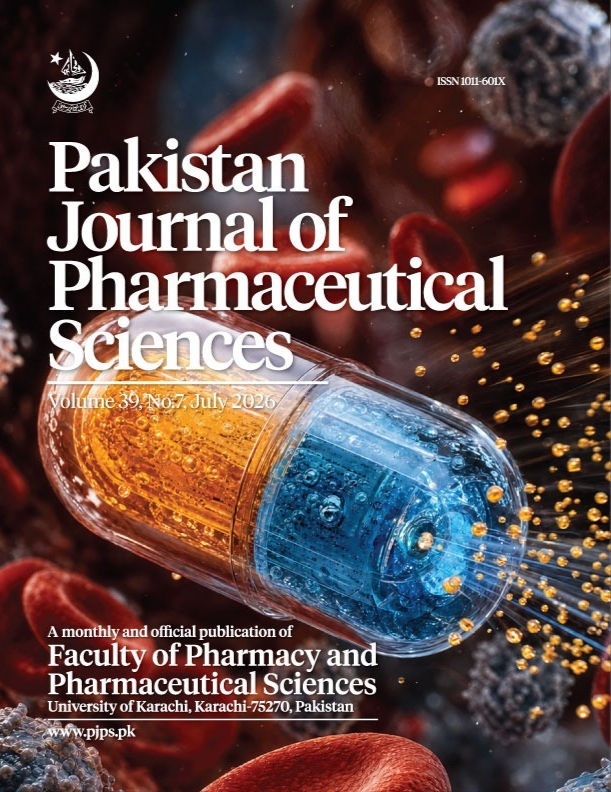
Journal Cover 39 Issue 11
0.6
IMPACT FACTOR
Clarivate Analytics
1011-601X/3105-9686
ISSN PRINT / ONLINE
Since 1988
12500+
TOTAL CITATIONS
Google Scholar
6000+
ARTICLES PUBLISHED
Peer-Reviewed
100+
COUNTRIES REACHED
Global Readership

Latest Research Articles

Browse All Articles
original articlesPublished: 01 Dec 2026
Volume 39, Issue 12

Corrigendum to: Bone marrow mesenchymal stem cells relieve rheumatoid arthritis by blocking JAK/STAT and TLR-4/NF-κB pathways

The authors have informed the Pakistan Journal of Pharmaceutical Sciences (PJPS) of an error in Figure 5 of the published article. During the editorial revision process, an incorrect version of Figure 5 was inadvertently included in the final published version. The authors have confirmed that the extreme-right panel (panel D) should be removed and that the remaining panels constitute the corrected Figure 5.Accordingly, Figure 5 is corrected by removing panel D. No other part of the figure is modified. The caption of Figure 5 remains unchanged, and no other figures or content of the article require modification. This corrigendum records the correction to the published version of the article. The correction is limited to the removal of panel D from Figure 5.

Page No:3940
Shilin Lian#, Xiao Ma#, Yichen MengView more
View Abstract
original articlesPublished: 01 Dec 2026
Volume 39, Issue 12

Corrigendum to: An in vitro method to study pancreatic acinar cells and centroacinar cells: Co-culture of rat pancreatic acinar cells AR42J and human pancreatic ductal epithelial cells HPDE6-C7

The authors request to change the acknowledgment statement section because of mistake in the statement. The correct acknowledgment is mentioned in the text below: “The present study was funded by the joint project on Regional High Incidence Diseases Research of Guangxi Natural Sciences Foundation under Grant No. 2024GXNSFAA010406 and the National Natural Sciences Foundation of China under Grant No. 81970558”

Page No:3939
Yifang Huo, Huiying Yang, Zhihai LiangView more
View Abstract
original articlesPublished: 01 Dec 2026
Volume 39, Issue 12

RETRACTED ARTICLE: Preparation of smart PVP/HPMC based IPN hydrogel, its characterization and toxicity evaluation

Following a complaint and technical (editorial) investigation, the authors were requested to provide essential documentation to verify the reliability, validity, and ethical compliance of the study published. Despite repeated reminders, the required documentation was not provided. Specifically, the authors did not correspond or supply: Raw Data: Original, unedited high-resolution microscope capture files and supporting raw laboratory datasets for the toxicity evaluation. Image Documentation and proof of originality: Original source files of Figure 11 (histological panels), with confirmation of their originality and linkage to the raw dataset (due to suspected image reuse and unauthorized duplication across panels). Laboratory Records: Relevant lab logbooks and supporting documentation verifying the experimental timeline. Clarification of Methodology: Clear description and additional supporting information for the histological sample preparation and image acquisition procedures for methodological transparency. 

Page No:3938
Hammad Yousaf, Ikrima Khalid, Kashif BarkatView more
View Abstract
original articlesPublished: 01 Dec 2026
Volume 39, Issue 12

LncRNA PVT1 in bone marrow mesenchymal stem cells suppresses prostate cancer progression via targeting miR-122 in tumor microenvironment

Abstract: Background: Prostate cancer progression is influenced by the tumor microenvironment. Bone marrow mesenchymal stem cells (BMSCs) can modulate tumor behavior, but the role of their lncRNA PVT1 is unclear. Objective: To investigate whether lncRNA PVT1 in BMSCs regulates the malignant phenotype of prostate cancer cells through miR-122 and elucidate its mechanism of action in the tumor microenvironment. Method: Rat BMSCs were isolated and cultured and a Transwell co-culture system was established with human prostate cancer cell lines (PC-3). RT-qPCR was used to detect the expression of PVT1 and miR-122 in BMSCs and cancer cells. PVT1 was overexpressed and knocked down in BMSCs to observe its effects on cancer cell proliferation (CCK-8), apoptosis (flow cytometry) and cell cycle (PI staining) in the co-culture system. The targeting relationship between PVT1 and miR-122 was validated using a dual-luciferase reporter assay. Rescue experiments were performed by simultaneously manipulating PVT1 and miR-122 in BMSCs. Results: In prostate cancer patient tissues and cell lines, PVT1 expression was downregulated while miR-122 expression was upregulated. In the co-culture system, overexpression of PVT1 in BMSCs significantly inhibited cancer cell proliferation, arrested the cell cycle at the G0/G1 phase and promoted apoptosis. Conversely, knockdown of PVT1 in BMSCs promoted the malignant phenotype of cancer cells. Mechanistically, PVT1 directly targeted and negatively regulated miR-122. Overexpression of miR-122 reversed the inhibitory effect of PVT1 overexpression in BMSCs on cancer cells. Conclusion: BMSCs exert a tumor-suppressive effect in the prostate cancer microenvironment through the PVT1/miR-122 axis, which may serve as a novel therapeutic target for prostate cancer.

Page No:3926-3937
Jun Liu, Xiaolei Xue, Aikepar• Abulajiang
View Abstract
original articlesPublished: 01 Dec 2026
Volume 39, Issue 12

ATI-2341 TFA promotes acquisition of epithelial-like immunophenotype in bone marrow mesenchymal stem cells and alleviates intrauterine adhesion in a rat model

Abstract: Background: Intrauterine adhesion (IUA) is a common complication of endometrial injury. Bone marrow mesenchymal stem cells (BMSCs) have been implicated in endometrial repair, but strategies to enhance their therapeutic efficacy remain to be optimized. The C-X-C chemokine receptor type 4 (CXCR4)/C-X-C motif chemokine ligand 12 (CXCL12) axis plays a pivotal role in BMSC homing. Objective: This study aimed to test the hypothesis that ATI-2341, a functionally selective allosteric regulator of CXCR4, enhances the therapeutic efficacy of BMSCs in a rat IUA model. Methods: After establishing the endometrial injury model, rat BMSCs were extracted and treated with ATI-2341 TFA (100 ng/mL). IUA model rats were randomly divided into model control group, BMSCs group, BMSCs+ATI-2341 TFA group, BMSCs+PBS group and Positive control group (n=10 each). Endometrial thickness was assessed by hematoxylin and eosin (HE) staining; cell proliferation by the methyl thiazolyl tetrazolium (MTT) assay; matrix metalloproteinase-9 (MMP-9)/tissue inhibitor of metalloproteinase-1 (TIMP-1) protein expression by Western blot; and cytokeratin and vimentin expression by immunohistochemistry. Results: ATI-2341 TFA-pre-treated BMSCs significantly increased endometrial thickness compared to untreated BMSCs (P < 0.05) or estrogen (P < 0.05). ATI-2341 TFA enhanced BMSC proliferation at 48 h (P < 0.05) and 72 h (P < 0.05). BMSCs exposed to ATI-2341 TFA or estrogen exhibited strong cytokeratin positivity and vimentin negativity. MMP-9 was downregulated (P < 0.05) and TIMP-1 upregulated (P < 0.05) in the ATI-2341 TFA group relative to controls. Conclusion: ATI-2341 TFA promotes acquisition of epithelial-like immunophenotype in BMSCs within the injured endometrial microenvironment and is associated with improved endometrial morphology in IUA rats. These findings provide preliminary evidence for the functional modulation of BMSCs by CXCR4-targeted therapy in endometrial repair.

Page No:3915-3925
Linhua Zhu, Yongfang Yue, Lili Cao
View Abstract

Browse by Topic

Research Scope & Subjects

Editorial Leadership

View Former Editors-in-Chief

Prof. Dr. Harris Shoaib

Editor-in-Chief

Faculty of Pharmacy and Pharmaceutical Sciences, University of Karachi, Karachi, Pakistan.

Specializing in Pharmacognosy and Natural Products Research, with over three decades of contribution to global pharmaceutical sciences.

2020 — PRESENT

Indexed & Abstracted in Leading Databases